Monetary Policy in Times of Geopolitical Fragmentation
Isabel Schnabel, member of the Executive Board of the ECB, was our guest. Read more about her insights into the current economic situation.
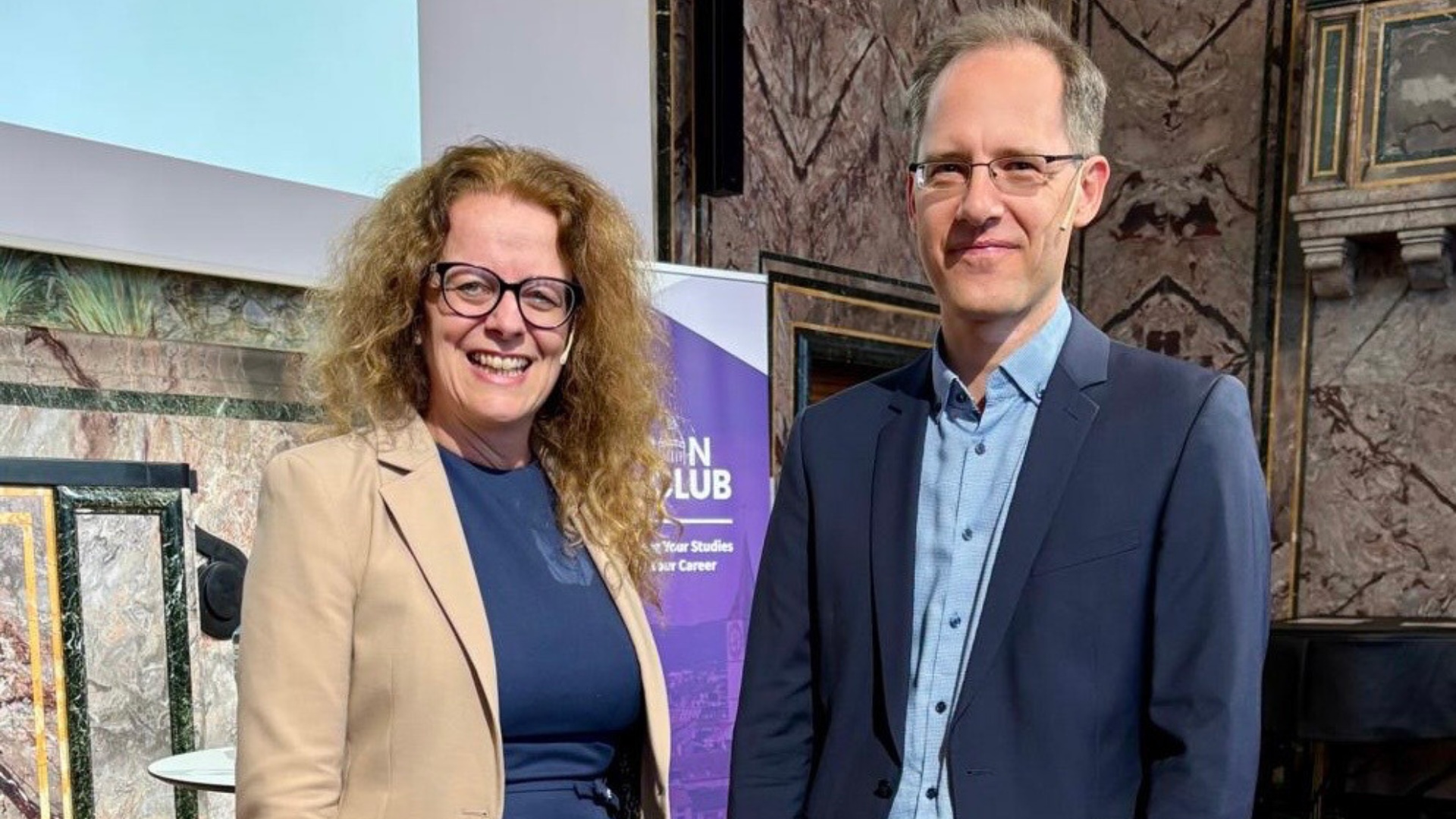
In recent years, the European Union has faced three major supply-side shocks. A fourth has now emerged with the war against Iran, which has already triggered a massive energy price shock, and additional pressure points, due to the rise of fertilizer prices, are expected in the months to come. How does the European Central Bank navigate these uncertain times?
We had the great honor of receiving a firsthand answer to that question from Isabel Schnabel, Member of the Executive Board of the European Central Bank (ECB) and Professor of Financial Economics. Professor Schnabel shared her insights at a recent event hosted at UZH, organized by our Econ Alumni association in collaboration with the Econ Club, the student economics association of our department.
Acting with restraint
Each crisis carries significant implications for monetary policy and ECB projections have become extremely difficult to formulate given how rapidly the geopolitical situation is evolving. To this end, policymakers are now working with scenario-based analyses differentiated by shock intensity, rather than single-point forecasts.
A supply shock is particularly challenging: it pushes inflation up while simultaneously dragging growth down, but in such a scenario, the standard prescription is that policymakers can "look through" the shock, provided a temporary shock does not evolve into persistent inflation.
Regarding the situation we are facing today, the ECB's stance is therefore one of careful balance: agile and vigilant, but without any need to rush into action. Schnabel pointed out that "There is time to observe how the situation unfolds". While it is too early to forecast the full extent of the impact on the real economy, she was clear: "If inflation becomes permanent, we will need to act." She acknowledged that the current situation is extremely difficult. "We will do everything to fulfill our mandate and guarantee price stability," Schnabel stated. Beyond these immediate shocks, the EU had been facing deeper structural headwinds.
Overcoming structural challenges for the EU
Demographic ageing is shrinking the labor force, climate change poses an additional drag, and even before the tariff shock, EU global trade had already been retreating, largely due to China's rise as a direct competitor to European industries. However, several levers could help strengthen the EU's position.
First, reducing internal trade barriers would unlock the full benefits of European integration. Second, increasing investment in defense, particularly in defense-related R&D, could have a meaningful positive impact on GDP and innovation. Third, reducing external dependencies remains a key priority: expanding renewable energy is a path Europe is already pursuing, while the introduction of the digital euro, by creating a pan-European payment infrastructure, could reduce reliance on US-controlled systems. Fourth and finally, the rapid adoption of AI is essential: "Europe missed the first digital revolution, which is why the EU has fallen behind the US in productivity. We should not repeat that mistake."
Navigating with the uncertain impact of AI
In the short run, an AI boom could prove inflationary since valuations and expectations around AI are enormous, but returns on investment remain unclear. Over time, however, if productivity gains materialize, it should be dis-inflationary and given the looming demographic scarcity of labor, AI may be essential to fill the gap on the labor market.
To the audience, which included many students, Schnabel said without hesitation: "You will have to stay on top of things in AI. Agent-based tools are something you will need to learn, there is no way around it." Yet she cautioned against over-reliance on the technology as AI risks affecting our cognitive abilities: outsourcing our thinking entirely would mean that we would stop learning and stop retaining knowledge. The message she delivered to the audience was unambiguous: "We first have to be good, otherwise we could face cognitive decline."