The Measurement of Inequality and the Limitations of Standard Methods
Ingvild Almås recently held her inaugural lecture, where she presented an overview of her past and current research.
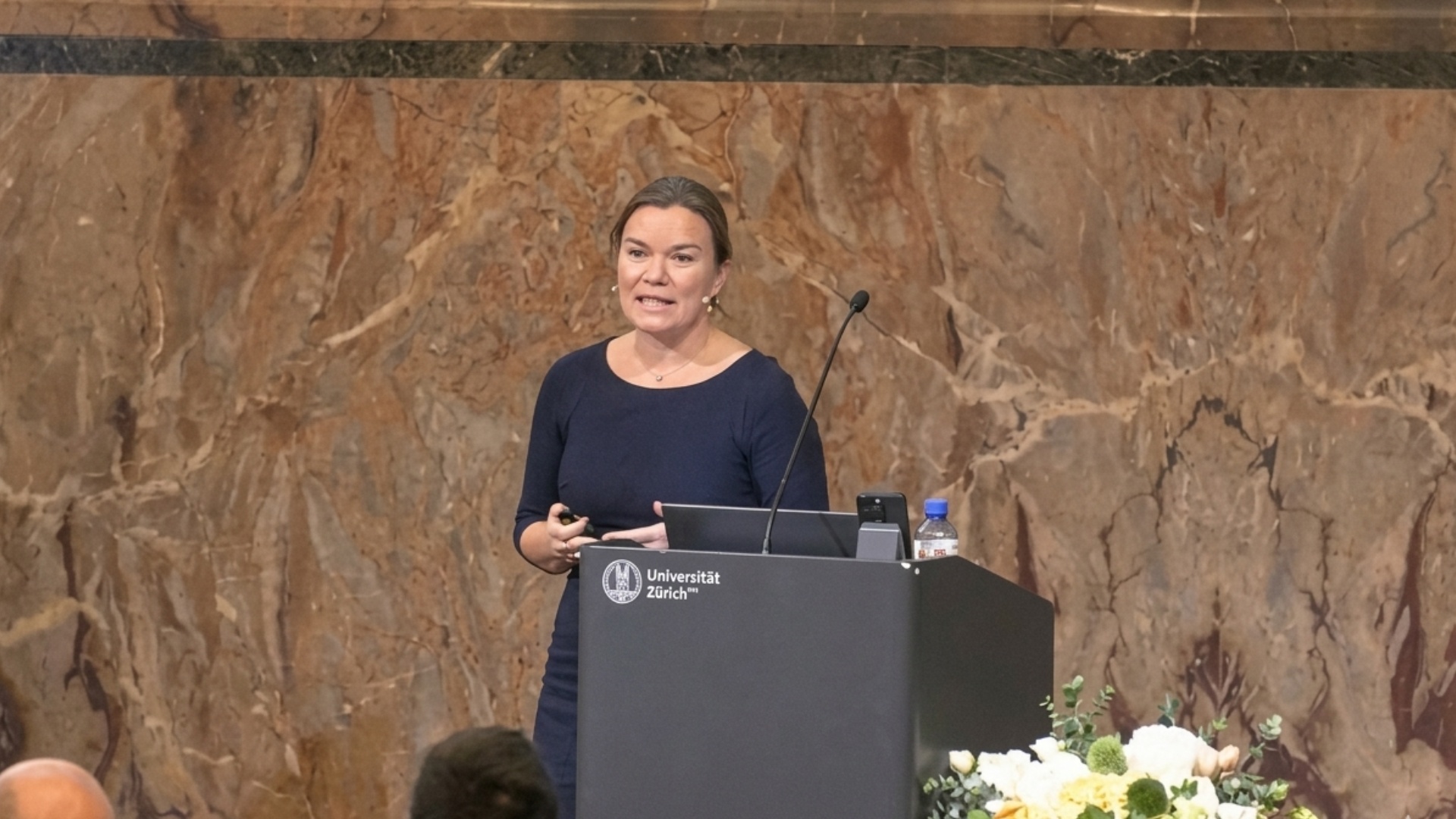
Ingvild Almås, Larsson-Rosenquist Foundation Professor of Economics of Child and Youth Development with a focus on breastfeeding, has spent her career questioning whether numbers are reflecting the reality. In her inaugural lecture, she presented an overview of her past and current research and explained how she has addressed this topic throughout her academic career.
The price of comparison
At the heart of measuring global inequality lies a deceptively simple problem: how incomes across countries with different price levels should be compared? The economic tool that is commonly used is the purchasing power parity, yet Almas has long been questioning of how it is constructed. Rather than relying purely on statistical aggregates, she champions an economic approach grounded in actual consumer behavior. She carried out her doctoral research using “Engel curves”, an economic indicator that examines the relationship between household income and expenditure, particularly for food, and reveals that lower‑income households spend a disproportionately higher share of their income on food. Almås came to a novel and striking research outcome: the poorer a country, the more its real income tended to be overestimated by existing methods. For the very poorest nations, the exchange-rate-based method often performed better than supposedly sophisticated adjustments. It was a finding that unsettled the field and ultimately earned her a seat at the table as an advisor to the World Bank’s International Comparison Programme, the very institution she had begun her career by gently critiquing.
Inequality in the household
Even if national income figures were perfectly calibrated, they would still obscure a deeper problem: who, within a household, controls the resources? Standard economic data treats households as single units, either inflating inequality by ignoring income sharing, or masking it by assuming equal sharing where none exists. Almås has developed methods to estimate intra-household resource allocation across countries, from Bangladesh to Denmark, and the results vary dramatically. In Denmark, women appear to command equal or greater shares; in Japan and Bangladesh, men tend to hold more. In countries such as Bangladesh, properly accounting for within-household inequality reveals significantly higher female poverty than headline figures suggest.
Rethinking the "target mothers" consensus
Development policy has long held that transferring cash to mothers produces better outcomes for children. Almås's field experiments in Tanzania complicate that picture. In her ongoing randomized controlled trial, couples were invited to a lab and asked to allocate resources between themselves, their spouse, and their young child. Mothers in the control group did give slightly more to children, but the gap was modest and closed entirely among those in the treatment group. More revealingly, fathers who received cash transfers combined with a parenting information program shifted their allocations meaningfully toward their children. The implication is significant: if fathers are the primary decision-makers in the household and respond more strongly to information and resources, policy that exclusively targets mothers may be missing the larger lever for change.
What people actually think is fair
Finally, Almås presented her latest research area: standard inequality measures implicitly assume that any deviation from perfect equality is a problem, but is that what people actually believe? In a sweeping study spanning 60 countries and representative samples covering 80% of the world's population, she and her collaborators asked spectators to allocate income between workers in scenarios where inequality arose from luck, productivity, or redistribution costs. The results show that most people accept more inequality when it reflects genuine differences in effort or productivity. The meritocratic instinct is strong, though far stronger in Western countries than elsewhere. Efficiency concerns, by contrast, matter far less to ordinary people than economists have long assumed. Perhaps most provocatively, a large share of respondents across all 60 countries agreed with the statement that the rich are richer because they have been more selfish — a belief that is stronger among poorer and less-educated respondents, and one that correlates with disbelief about social mobility.