Deciding for others makes us less confident – even when we are just as competent
Why do we hesitate when making decisions that affect others? A new study suggests that we trust our own judgment less as soon as we become accountable for other people.
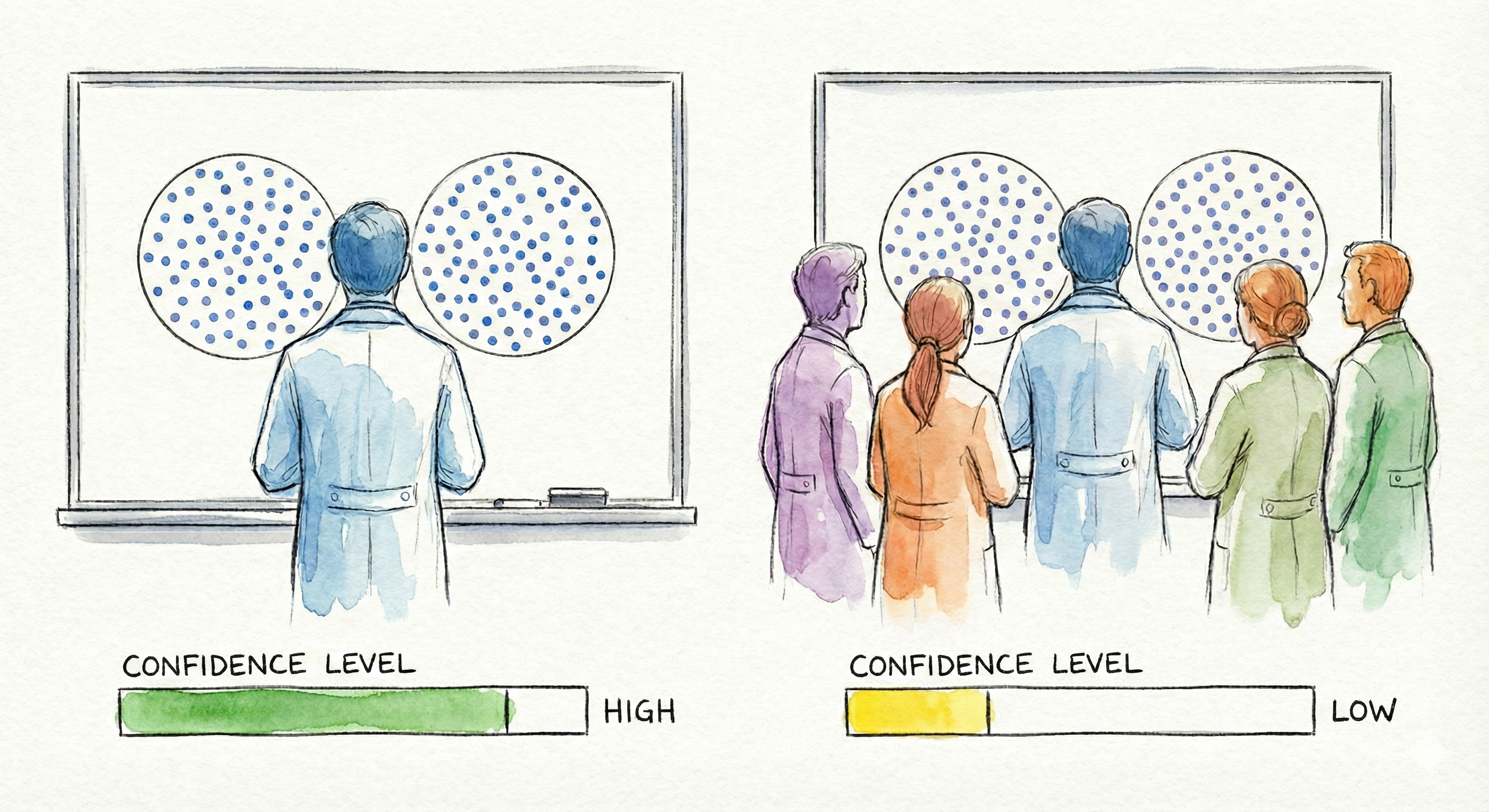
Making a decision is not always easy, even less so when it affects someone else. When we are faced with that responsibility, many of us hesitate, feel uneasy, or try to pass the choice on to someone else. New research from the Zurich Center for Neuroeconomics at the Department of Economics at UZH suggests that this "responsibility aversion" may start with a quiet shift in our ability to reflect on our decision-making process: we trust our own judgments less as soon as we become accountable for others.
Testing social responsibility without risk
Most studies on social responsibility focus on decisions involving risky gambles. But what if the change in behavioral responsibility operates on a more fundamental aspect of cognition, affecting a diverse range of tasks rather than specifically changing risk preferences? Sherry Dongqi Bao, Micah G. Edelson, and Todd A. Hare tackled this question by using behavioral paradigms that contain no risk at all. Through several experiments involving around 400 volunteers, participants were simply asked to determine which of two circles contained more dots. Because the correct answer was objectively defined, the researchers could separate accuracy from the participants’ subjective certainty.
Social responsibility was manipulated across different decision trials. In some runs, correct answers earned money only for the decision-maker (Self trials). In others, the answers determined payoffs for the whole four-person group the decision-maker belonged to (Group trials). After every choice, participants reported how confident they were, using an incentive-compatible procedure designed to make "honest" confidence ratings pay off.
Lower confidence, same accuracy
The researchers further discovered that responsibility changed how people felt about their decisions, not how well they performed. Participants were equally accurate in Self and Group trials, yet they reported reliably lower confidence when their choice affected their whole group. This confidence gap did not vanish when participants had unlimited time to gather evidence and decide, and it also persisted even when the participants were given feedback showing that their accuracy was the same across conditions.
A bias in self-evaluation
Using computational models that separate performance from self-evaluation point to a change in metacognitive bias showed the follwoing: when deciding for others, people became more underconfident relative to what their true actual accuracy level would justify. Additional computational modeling suggested a mix of increased caution and slower information processing under responsibility – i.e., social responsibility affects changes in multiple cognitive processes rather than pressing a single "panic button".
Why responsibility leads to delegation
In a separate task, participants could either decide themselves or delegate to "experts" with known accuracy (70% or 90%). The researchers developed a normative model based on confidence that predicts that delegation will become attractive when confidence in oneself drops below confidence in the alternative decision-maker. That is exactly what happened. The responsibility-induced loss of confidence was sufficient to explain why delegation increased when outcomes affected the group.
Not just about "more money at stake"
Using a non-social "high-stakes" version of the task, the authors found that higher monetary stakes made participants slower, but they did not make them less confident. These findings link the confidence effect under responsibility specifically to the social context. Further evidence for the importance of social factors comes from the finding that people tended to show a larger confidence drop when they felt more affiliation with their experimentally assigned group.
Implications outside the lab
Everyday responsibility, such as choosing a treatment plan, approving a loan, or making policies under uncertainty, often comes with pressure to avoid mistakes. This study suggests that part of that pressure is inherent to the way we operate: responsibility can tilt the mind toward underconfidence, even when objective competence is unchanged. Designing decision environments that support calibrated confidence, such as through shared accountability, and reducing hindsight-driven blame through written rationales and pre-mortem analyses may help people take responsibility effectively when it matters most. In human–AI contexts for example, those tool should communicate uncertainty and reasons, so delegation can be calibrated accurately rather than occurring automatically.
Sherry Dongqi Bao et al. "Deciding for others alters metacognition leading to responsibility aversion". Sci. Adv.12, eady0441(2026). DOI:10.1126/sciadv.ady0441