Annual Research Night 2026
A Showcase of Economic Research
.png)
The Annual Research Night is not only about celebrating achievements, it is also about showcasing the research that defines the Department of Economics. This year’s Research Slam featured three professors whose work illustrates the breadth of questions economists are tackling today.
Ingvild Almås, Larsson-Rosenquist Foundation Professor of Economics of Child and Youth Development with a focus on breastfeeding, explored how people across cultures distinguish between fair and unfair inequalities, extending a line of earlier research that resonates strongly with Ernst Fehr's pioneering work on fairness and social preferences.
Carmen Villa, Assistant Professor of Economics of Child and Youth Development endowed by the Jacobs Center for Productive Youth Development, examined how urban design and public housing can shape gang formation decades later, demonstrating how institutions and environments influence human behavior.
Ralph Ossa, former WTO Chief Economist and Vice President Faculty Affairs and Scientific Information, offered a timely assessment of a global trading system under pressure, explaining why rules-based cooperation remains a cornerstone of economic prosperity in an increasingly fragmented world.
Different questions, different methods, one common ambition: using rigorous research to better understand society and to help shape a better one.
Shaping Economics and Economists
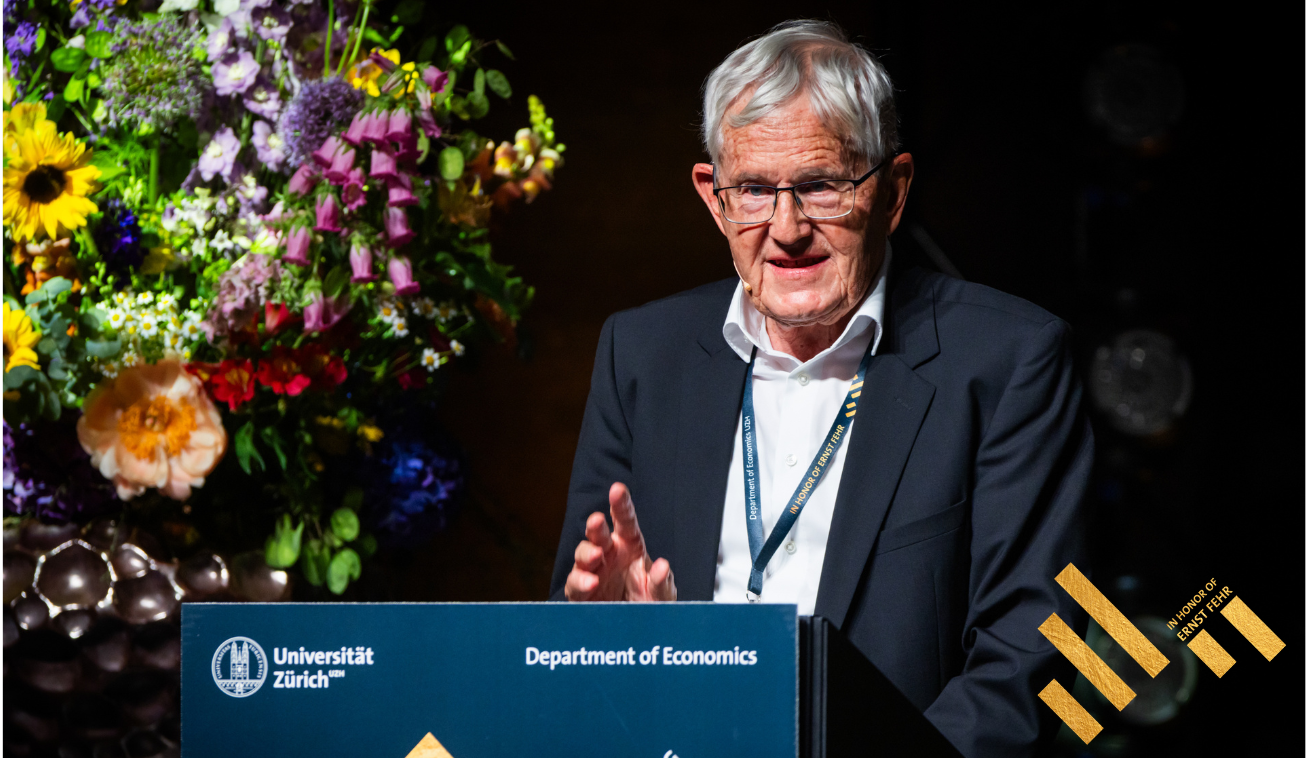
One of the highlights of the 2026 Annual Research Night was the tribute delivered by former Swiss Federal Councillor Kaspar Villiger in honor of Professor Ernst Fehr’s 70th birthday. Drawing on his own experiences in business, government, and finance, Villiger reflected on the impact Fehr has had not only on economics as a discipline, but also on the way we understand human behavior in society.
Villiger described meeting Fehr as a turning point in his understanding of economics. While traditional economic models often focused on the rational and self-interested individual, Fehr’s work helped explain many of the realities Villiger had encountered throughout his career.
“He bundled everything I had gathered in life as practical experience into logical economic and psychological frameworks. He demonstrated how crucial cultural and ethical factors are alongside institutions and supplemented the admittedly useful fictional construct of the homo oeconomicus with the complex, versatile, and emotionally driven real-world human being.”
Villiger highlighted Fehr’s pioneering contributions to behavioral economics, emphasizing his willingness to challenge established thinking and explore new questions. He credited Fehr’s success to a combination of intellectual curiosity, analytical rigor, and persistence.
“Foremost is undoubtedly his exceptional achievement as a researcher. It is the fruit of a never-fading intellectual curiosity, impressive clarity in thought and argumentation, and hard work.”
But Villiger stressed that Fehr’s impact extends well beyond his research contributions. Equally important, he argued, is Fehr’s commitment to educating and mentoring the next generation of economists.
“He was always aware that teaching, that is, passing on his knowledge to the next generation of academics, was of fundamental importance. He is, in fact, a gifted teacher who consistently inspires his students.”
Yet the tribute extended beyond research and teaching. Villiger emphasized Fehr’s lasting influence on the development of the Department of Economics and the UBS Center.
“Ernst Fehr also possesses a quality that is of great importance to the UBS Center and to the University of Zurich in general. I call it ‘reputational gravity.’ Thanks to Ernst’s excellent reputation, the UBS Center and the Department of Economics at the University of Zurich have consistently been able to attract outstanding professors.”
As Chairman of the UBS Foundation for many years, Villiger witnessed firsthand how Fehr helped transform Zurich into one of the leading centers for economic research in Europe. He also recalled the creation of the UBS Center, praising Fehr’s ability to inspire support for ambitious ideas and long-term investments in science.
“Today, we can note with satisfaction that the UBS Center, and with it the department, have garnered an enormous reputation. I had the privilege of accompanying this development for about ten years as President of the UBS Foundation.”
Concluding his tribute, Villiger thanked Fehr for his contributions to research, education, and society, while noting he remains driven by new goals he still intends to pursue.
“Thank you from the bottom of my heart for everything you have given to science, the UBS Center, the University, and thus to the entire country.”