Fostering the Next Generation of Economists
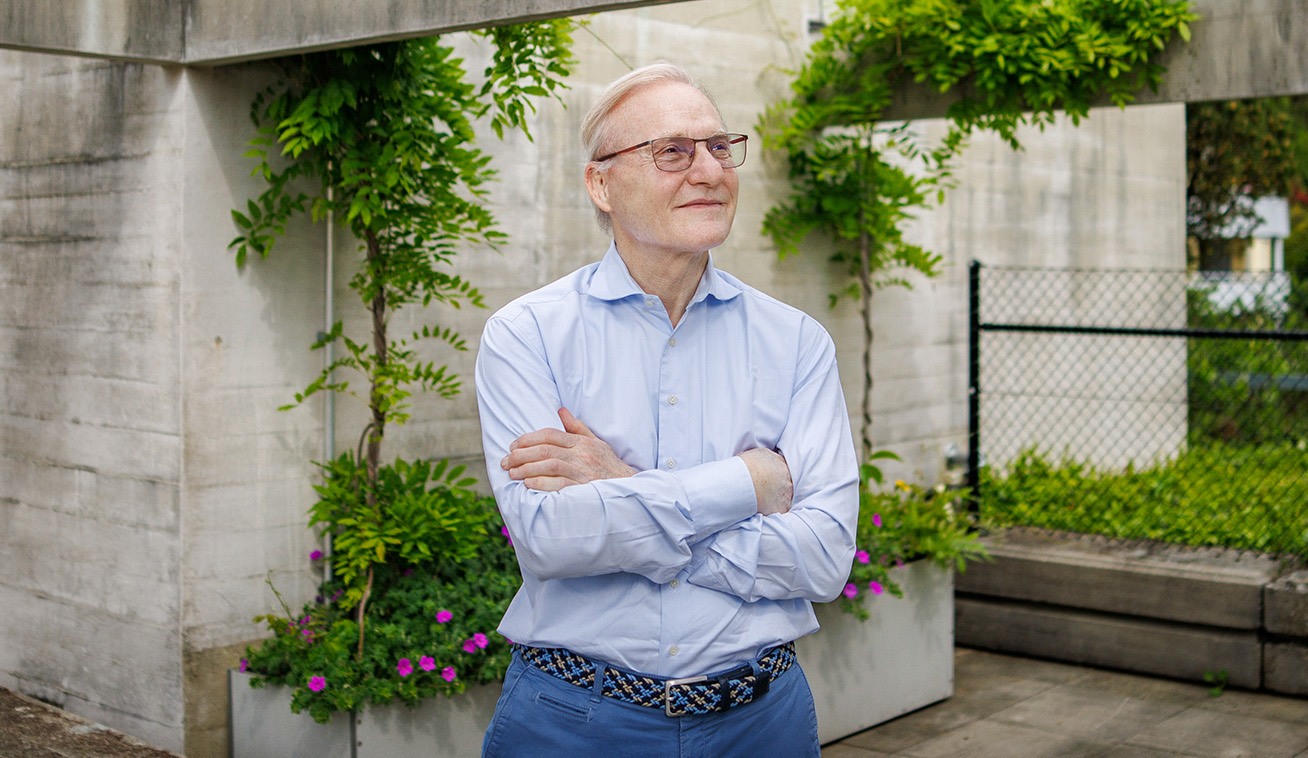
Thanks to Ernst Fehr, doctoral students at the Department of Economics can today pursue questions that would have been unthinkable a generation ago. Where economists once had to stay firmly within the boundaries of their discipline, students here now combine economics with neuroscience, mathematics, psychology, and beyond.
When Ernst Fehr became chairman of the department, he had a clear vision for the Zurich Graduate School of Economics: bringing the graduate school model of Top US Departments to Zurich. Rather than relying on a single supervisor, doctoral students would be guided by a committee of professors, ensuring richer mentorship, sharper feedback, and a stronger foundation for their research. The first major step was the abolition of traditional chairs in favor of professorships along American lines. This went hand in hand with the centralization of administration and doctoral training through the establishment of a graduate school. Whereas PhD students had previously been linked to individual chairs, the department instituted a unified doctoral pool. Bringing colleagues on board required careful consultation and genuine dialogue. Fehr engaged personally with each professor, listening, explaining, and building the shared conviction that this change would benefit the institution as a whole.
The result was the establishment of the Zurich Graduate School of Economics (Zurich GSE), supported by a newly founded doctoral framework and a clear program structure. The stated goal was ambitious but simple: 100 doctoral students researching together in a shared, internationally oriented environment. A similar process unfolded in the field of neuroeconomics. The doctoral program was initially funded through Ernst Fehr and later significantly expanded thanks to a generous donation from the Marlene Porsche Foundation.
A school built for the frontier
The Zurich GSE was launched in its current form in 2009 with the clear ambition to offer doctoral training that is genuinely world-class, not merely regionally competitive. Its graduates go on to positions at leading universities, central banks, international organizations, and private research firms. The program is taught entirely in English, attracting faculty and students from across the globe, and its curriculum is structured to move students from foundational mastery to independent, frontier research as swiftly and as deeply as possible. In the first year, students build fluency in the core languages of the discipline such as micro- economics, macroeconomics, and econometrics, not as introductions, but as immersions in state-of-the-art methodology. By the second year, they select field courses and seminars, sharpening their focus. By the third, they are researchers in every meaningful sense: designing studies, presenting work, and contributing to the intellectual life of one of Europe’s most productive economics departments. What distinguishes the Zurich GSE from comparable programs is not just the curriculum but the culture. A defining feature is the unusually close relationship between doctoral students and their advisors, a mentorship model that integrates graduate students to the department’s intellectual life. Students are collaborators, expected to develop a voice and a research identity from the very beginning.
Where economics meets the brain
In 2017, a donation from the Marlene Porsche Foundation enabled the expansion of the doctoral program in neuroeconomics. The faculty of the Marlene Porsche Graduate School of Neuroeconomics brings together expertise in biology, computational modeling, economics, neuroscience, mathematics, and psychology under one roof. The program grants students full access to the Laboratory for Social and Neural Systems Research (SNS Lab), equipped with neuroimaging facilities, neuropharmacological tools, and brain stimulation technologies that most universities could only aspire to offer. This interdisciplinary depth is not incidental. Why do people cooperate? How does trust form? What drives risk-taking and why do markets fail? Such questions cannot just simply be answered by economics alone. They require the tools of brain science, the precision of mathematical modeling, and the empirical discipline of controlled experimentation.
What comes next
If the Zurich GSE and the Marlene Porsche Graduate School of Neuroeconomics have one goal, as its next generation of students arrive, it is to offer the structure that ambitious researchers need, the freedom that curious minds demand, and the community that makes the long work of discovery feel worthwhile. Both programs have always understood that their greatest output is people. People equipped to ask questions the rest of us have not thought to ask yet.